Page: http://www.ameriblues.com/
Showing posts with label guitars. Show all posts

The Art of the Blues: Destruction, Devastation, Creation...ReTune Nashville...After the Flood. by Maureen Elizabeth


Inspiration comes in many forms. But who could imagine inspiration coming from a photo of a flood damaged guitar quietly sitting out at the curb waiting, not to be played, but to be purged.
Sheri O’Neal could imagine. And she could inspire. And she has taken that inspiration and breathed new life into the rusty echoes of flood damaged instruments. From this inspiration Retune Nashville was created.

The Purpose:

To offer relief to uninsured musicians in the industry through the sale of artwork created from these flood damaged musical instruments.

The Process:

Flood damaged music gear is donated to Retune Nashville and passed along to an artist who creates a 3D piece of artwork to be auctioned off for sale. Proceeds from the sale of the artwork will directly benefit uninsured musicians through MusiCares Nashville Flood Relief and the Nashville Flood Relief Fund.

The Struggle:

The music community was devastated as floodwaters ravaged storage facilities, venues and residences that housed musical instruments, tour rigs and other gear. "Today this community is struggling to overcome the huge loss they are now faced with and many have to borrow already scarce gear just to make ends meet." (ReTune Nashville)


An Artist: Nance Cooley

Nance Cooley is an artist who is experiencing both sides of the event. Nance’s husband, musician Bill Cooley, along with many others, lost his equipment which was stored at Soundcheck Nashville when flood waters devastated the facility. Following the flood, volunteers put all the equipment in triage in a warehouse. “It was so bizarre, they were like bloated corpses lying side by side on the warehouse floor,” Nance said, “some of it was literally irreplaceable, like collector’s items. It was heartbreaking to walk through.” Her husband also lost two handmade Galloup guitars which were very special to him. But as devastating as all of that was, they had friends who had lost their entire homes. “It was horrific,” Nance said,” we kept hearing more and more stories about people we cared about who had lost so much.”

Why did you get involved in ReTune Nashville??

As horrific as the loss of the instruments were for us, we were aware of how fortunate we are. Bryan Galloup, when he heard of my husband's loss, gave him another handmade guitar! I feel for the musicians and have a deep sense of loss, yet at the same time I have a perspective of what other people have also lost and as sad as it is, never really lose sight of that. This, to me, was a way to give back, to help someone else.

What pieces do you have to work with?

Guitars, dulcimers, violins, part of a keyboard, it’s incredibly eclectic. Some have tags, some have a back story, some are unrecognizable. I hope to create a 4 part piece.


So you are hoping to bring these instruments to life?


I am in a unique position. This is my husband’s livelihood. He has played with Kathy Mattea for the past 20 years . I know how you cherish things when someone gives something to you. And to see these cherished items collected into pieces is heartbreaking. Yet they are still beautiful - the softness of the wood contrasting with the hardness of the electric pieces. Of course you can’t be an artist and not want to take them apart. Now I have the opportunity to turn them into something – I have the opportunity to regenerate what was lost into something beautiful.


A Musician: Andy Zimmerman

The flood devastated many members of the musical community. Andy Zimmerman, Mike Williams and Christ Mironescu are members of the band “The Running” whose music is described as “a funky mix of rock reggae and blues.” Read Andy’s journal account of the flood as it swept into his girlfriend’s home…

Friday, April 30th 2010
After work, I went straight to sound check at Exit/In (where my band was playing that night). Following sound check, I went home, showered, ate, and returned for the show. We went on around 11:30pm and played until about 1:30am. As we loaded our gear in the back of my 08’ Ford Escape (that I just bought a month ago), someone was telling me that a bad storm was coming through the next day. Taking that advice, we decided to leave the gear loaded and head out for our show in Knoxville early to get ahead of the rain.

Saturday, May 1st 2010
Awoken by my bass player Christ’s phone call around 10:30am, I could already hear the rain outside. Luckily, we did get ahead of the storm and the drive to Knoxville wasn’t that bad. Arriving around 4:30pm EST, we had just enough time to grab something to eat and get to the venue for sound check at 6pm. The show started around 9pm and we went on around 11. After the show, we were all just ready to go home and sleep in our own beds rather than unfamiliar couches (and possibly floors), so we headed out.

Sunday, May 2nd 2010
Arriving in Nashville around 4am, my girlfriend Michelle and I decided to stay at her place because we didn’t want to wake up my roommate. In retrospect, that was one of the worst decisions EVER. As I parked in her driveway, I noticed her backyard had been flooded by Saturday’s storm. Like I said earlier, we hadn’t talked to anyone at this point and had no clue that another round was on its way. For all we knew, we were going to sleep till noon and have a lazy Sunday to rest from the busy weekend.

It was exactly 8:41am when Michelle woke up because of the heat (apparently the AC unit was already under water). I shot straight out of bed to her screaming at me from the kitchen, looking at this:


Trying not to panic, I was thinking I might be able to wade out and save some of the band’s gear. Luckily, I noticed the water level in the garage before I got dressed. When I glanced again right before I headed outside, the water had risen approximately 6 inches in the matter of 5 minutes. I abandoned that plan real quick and switched my focus on getting us to higher ground. The current was rushing straight at the house, so swimming was out of the question (not to mention idiotic). No options left but the roof. By the time we got our important stuff into zip lock bags and stuffed in our pockets, this was the scene in her living room:


By the time I boosted Michelle up on the roof and stacked a pile of patio furniture to get up, it was around 9:15am. Notice the mailbox, lawn mower, and covered boat (top right by the white truck)


We called the authorities and notified them we were stuck on the roof and they pretty much said they would get to us when they could, but thousands of other emergencies took precedence. So there we sat, while someone threw buckets of water on us from close range. ~11:30am: (lawn mower was now in the backyard)


The toughest part of the whole situation was actually watching as the water rose inside my car, submerging our whole band’s gear.


Finally, a couple awesome neighbors came by in their fishing boat and rescued the older couple next door, then came back for us. By the time we jumped off the roof into the boat, the water was only about 3 or 4 feet from the gutters. I slept good that night for sure.


http://www.TheRunning.us
Guess we really are just a “dirty old garage band”

ReTune Nashville announced that the Benefit Concert and Art Auction Event is set for Saturday, October 23, 2010 at Nashville gear storage facility and rehearsal space, Soundcheck.
ReTune Nashville founder Sheri ONeal comments about the importance of using Soundcheck as the venue for the event, “From inception, we wanted to have the event at Soundcheck. It was suggested by musicians, and it's the place where a lot of heart-breaking damage was done. We wanted to turn something negative into something positive for the facility and for the musicians. We couldn’t think of a better place to hold the event.”To date, ReTune Nashville has collected more than 60 damaged instruments from the Nashville floods of May 2010 with more than 50 visual artists committed to bringing them new life.
For more information go to Retune Nashville at www.retunenashville.org

Custom Lowebow Cigar Box Guitars by Robert "Nighthawk" Tooms


(Memphis, Tennessee) I am on the road with the Reba Russell Band this week playing blues festivals and clubs in Tampa and Jacksonville Beach, Florida, but stopping for a bit to write a few lines before my long drive back to the Home of the Blues. Thanks to all our friends in Florida for their kindness. They love the blues in Florida as much as anywhere I have ever been. We'll be back soon to play again.

The band goes to Florida, image by Donna Donald Design


Many years ago, I was honored to take my band to play at the wedding reception of John and Beverly Lowe. These two wonderful and friendly intellectuals became good friends over the years and I frequented their super cool bookstore called Xanadu, which they started in East Memphis in 1987.

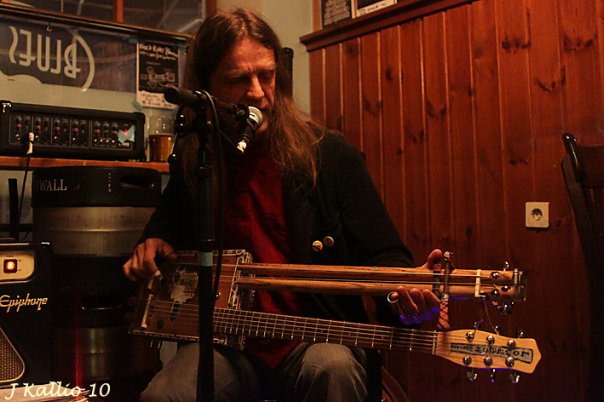
In 2000, Xanadu moved to 2200 Central Avenue in Memphis across from the delicious food at Central Barbecue and John has expanded his offerings to include lots of stuff for guitarists and musicians. At the zenith of his creative endeavors is his love for the cigar box guitar. After experimenting with many designs over the years he has become famous as the author of the Lowebow guitar. It is named after him and the diddly bow, the original one stringed instrument of the Delta, sometimes made of a broom wire and played on the wall of a wooden building. John's instruments expand the idea of this instrument and take it to the limits of imagination.

Johnny Lowebow also performs with his guitar and he has always prized vintage tube amps, loving the old Orange amps and other esoteric musical paraphernalia. Listening to one of these guitars in the hands of a creative player is quite an experience. I remember hearing my friend, Richard Johnston, playing one when I went to Brad Webb's studio to cut a couple of tracks on his first big CD, Foot Hill Stomp.

The Lowebow makes some wild tones when amplified and you have to hear it to believe it.

Here's Johnny Lowebow explaining and playing this crazy and fascinating instrument:


Bobblehead of our buddy, Microwave Dave, playing the Lowebow

Cateye Resonator Hill Harp Lowebow #1


Typical selection of guitars for sale at Xanadu


Masonite Johnny Lowebow Personal model

More Lowebows


Jukka Juhola plays his Lowebow Underslide

John was quoted in the Memphis Daily News, "It was a major breakthrough because it enabled you to play the bass parts as well as the guitar parts. With the addition of foot drums, it became a one-man band."
- John Lowe
Xanadu Music and Books owner, on his Purgatory Hill Harp

John uses red oak, maple and mahogony for the necks and cigar boxes from a local tobacco store and can make a one-string cigar box guitar in a day. Those start off at $140 and can be set up as a guitar or bass, depending on the size of the strings musicians use. Multiple-string guitar box guitars can take two to three days to make. Some of the double-neck guitars can sell for up to $700.

Lowebows are a magical instrument that is accessible to beginners and professionals alike. They make an excellent teaching instrument and playing technique is as individual as the player. You will have a hard time finding something more fun and rewarding to play. Thanks to John Lowe for all the photos of his fine guitars.

To get your own custom Lowebow, call my friends Johnny Lowebow and his wife, Beverly, at Xanadu 888-838-9885, in Memphis Call 274-9885 or send an e-mail to bevlowe@bellsouth.net.

Here's a video of my friend, Richard Johnston, playing the Lowebow:


Check out my website: http://www.RobertNighthawkTooms.com/

RCT

©Robert "Nighthawk" Tooms, 2010

NEW YORK: Strange Brew (Book Review)- by J. Blake

When we, the writers of American Blues News, were asked to give Holiday gift ideas, I have to admit that I was a little stumped. For the past few months I have been writing CD reviews for some potentially great stocking stuffers, but when faced with the task of actually suggesting an item as a “great gift” for blues lovers everywhere, I really had to give it some thought. What I came up with is something I’m sure some of my fellow ABN writers will cringe at, not because it is a bad gift idea, but because it does not deal with “American blues”. The item in question is a book titled STRANGE BREW: ERIC CLAPTON & THE BRITISH BLUES BOOM 1965-1970 by Christopher Hjort.

The title can be a little misleading. This is not a book about Eric Clapton. It is in fact an almost day by day archive of the entire professional (and at times personal) lives of the British blues scene’s most notable groups and musicians. Yes Clapton was unquestionably a huge part of this particular music movement, but in addition to chronicling every move “Slowhand” made and every band he participated in over this 5 year period, the book also pays equal attention to John Mayall’s Bluesbreakers (both with and post-Clapton), The Rolling Stones and Fleetwood Mac (as well as following a few other groups in slightly less detail). If you really break it down, it seems to zero in specifically on the professional lives of John Mayall and his three most noteworthy blues guitar alumni, Eric Clapton, Peter Green and Mick Taylor.

Now I’m sure some of you are sitting there saying to yourselves “that’s pretty cool”, but you have no idea! When I say an “almost day by day archive”, I mean “day by day”. The book is laid out like a journal, in chronological order starting in January of 1965 and going through December 31st of 1970. Some of the early months are left pretty vague and it does not include an entry for every single day, but it is quite astounding just how detailed Hjort manages to get. You can literally pick almost any day, flip to it in the book and see which bands played that day, which venue they were at and who was on the bill with them. In many cases Hjort even includes show notes, snippets of interviews and excerpts from concert reviews written at the time for publications like Melody Maker and New Musical Express. The inclusion of this kind of information undeniably provides an insight to not only the times, but in many cases even the temperament of the audience and the set list. For instance the entry for Monday October 5, 1970 shows that Derek & The Dominos played at the Town Hall in Birmingham England. The entry includes portions of a review written for New Musical Express that not only slam Clapton’s vocals and recall the fact that a fire hydrant blew in the venue, soaking the spectators, but also confirms a few of the songs from the set list and reveals a catastrophic missed opportunity. According to the NME reviewer, “Robert Plant casually wandered on stage. It was obviously unplanned. None of the group saw him. Few of the audience seemed to recognize him. And nor, apparently, did the roadie guarding one of the wing stage doors. Robert Plant was unceremoniously ushered back through the door, and the chance of a monster impromptu jam session was gone.”

Remarkably the wealth of this book’s information is not restricted to just live concert dates and first-hand show accounts, it also manages to do as good of a job covering things like radio & television appearances, fairly unknown all-star jams, recording sessions & album releases. Ever wonder what it would’ve been like to see The Paul Butterfield Blues Band jam with Cream? Well according to a periodical called the Record Mirror, some lucky London club-goers got to witness it on Wednesday October 19, 1966. Ever wonder about how Mick Taylor came to join The Rolling Stones? The joint entry of June 1 & 2, 1969, discusses how Taylor’s “trial run with the Stones” went well, explaining that he was brought back in for a second session; where they worked on the song ‘Honky Tonk Women’ until the wee small hours of the morning. A separate entry for Monday the 2nd goes on to explain that just 10 days after Taylor left The Bluesbreakers, he was officially asked to join The Rolling Stones, but according to the following day’s entry, he was sworn to secrecy, because the band had not yet notified Brian Jones that he was being replaced.

When you take into account that in addition to this book’s interviews, reviews, dates, facts, trivia and gossip, it also includes a foreward by John mayall, some amazing photos, illustrations, complete discographies and even musical equipment information, this book proves to be an absolute must for any British blues fan. Sure, it would’ve been nice to include a few more bands and it would’ve been even nicer to include more complete set list information, but what I’ve described above really isn’t even the tip of the iceberg. We’re talking about hundreds of informative and entertaining entries. What Christopher Hjort managed to do with this book is nothing short of amazing and I can’t recommend it enough.

Happy Holidays!!!


*For other gift ideas, check out our CD Review page.


Copyright © 2009 - J. Blake. All Rights Reserved


NEW YORK: Howlin' For Hubert Concert Review - by J. Blake

On Tuesday night, November 24th, New York City blues fans were treated to a program of music titled “Howlin’ for Hubert” at B.B. King’s Bar & Grill in Time Square. New York Dolls front-man David Johanson and legendary blues guitarist Hubert Sumlin, led a band of solid professionals through two sets of authentic electric blues that paid tribute to one of the genre’s most beloved and respected figures and Sumlin’s former employer for over 20 years, Mr. Chester Burnett a.k.a. Howlin’ Wolf.

Sumlin, who celebrated his 78th birthday the night of the performance (though his birthday was actually on the 16th), could easily be called “long in the tooth” and is unfortunately past his prime. The elderly bluesman’s singing voice is not exactly strong, which is not helped by the fact that he now operates with only one lung. His fingers don’t quite move with the fluidity that they once did and on more then one occasion, Johanson had to notify him that he was playing in the wrong key. However, with all that said, he came across as very charming and funny and he commanded the stage with a vigor that the rest of us will surely envy when we’re his age. He is a veteran and a legend and despite the negatives, it was a thrill to see him perform in such a small venue.

Johanson, not really a “bluesman” by trade, was clearly the conductor of the group; calling out songs and keys, choosing what musician should solo and where they should do it, etc. His stage presence is probably a little too flamboyant for some blues fans, but it is entertaining and it compliments the shear comedic irony of a wafer-thin glam-punk rocker singing Wolf classics like Built For Comfort (I Ain’t Built for Speed) and 300 Pounds of Joy. His larger than life persona and the “unpleasant” gravely quality of his voice, surprisingly make him the perfect candidate to carry the Howlin’ Wolf torch. I can’t imagine too many front-men being able to pull off the material as well as he does.

The band itself was clearly made up of experienced professionals. Unfortunately it was also quite clear that this was not a band that plays together regularly; but instead a group of hired guns called in for the evening. They lacked the tightness that comes from taking the stage together as a band night after night. Though great blues is sometimes played with a certain tastefully executed looseness, the music of this particular evening was at times perhaps a little too loose; featuring a few too many sloppy intros and missed endings. From experience, I’m aware that such things happen from time to time, but for a group of musicians of that caliber, charging the cover that they were charging, these kinds of mistakes should be kept to an absolute minimum.

Now as many of you are muttering to yourself “the nerve of this guy”, referring to my negative comments, I assure you that I only call it as I see it. I have seen Hubert Sumlin play before and this particular evening was not one of his better performances, but despite all the mistakes and all the negatives (not all of which can be attributed solely to the blues legend), it was a very enjoyable night of blues music. Though Sumlin and Johanson have been working together for a few years now, the pairing is still unique to say the least and a program of almost exclusively Howlin’ Wolf classics is both rare and a welcome treat. It was far from the best show I’ve ever seen, but it was fun and I would certainly recommend seeing this unlikely duo to all blues lovers.


*If you enjoyed this article, you may also enjoy: Psychedelic Blues Power

Copyright © 2009 - J. Blake. All Rights Reserved.
*Live Photos: Copyright © 2009 - Nelson G. Onofre. All Rights Reserved.


NEW YORK: Derek Trucks' Already Free CD Review - by J. Blake


I’ve been attempting to keep my recent CD reviews as current as possible, but when an album has been a staple of Billboard’s Blues Music Top 10 for 44 weeks, it really needs to be mentioned. ALREADY FREE marks The Derek Trucks Band’s 6th studio effort and reflects a maturity that can only come from experience and life lessons learned. The blonde pony-tailed guitar prodigy is now 30 years-old, the husband of fellow seasoned blues performer Susan Tedeschi and a father of two. He’s played with everybody from Buddy Guy to Eric Clapton, has been a member of The Allman Brothers Band for a decade and has led his own self-titled group since 1994. He’s a guy that has packed a lot of living and performing into a relatively short lifetime and if ALREADY FREE is the fruit of all the labor it was certainly all worth it.

The album runs 12 tracks (with Best Buy and iTunes editions reportedly featuring “bonus tracks”), features guests like Susan Tedeschi, Doyle Bramhall II and Oteil Burbridge and finds Trucks and his band fusing blues and soul with a touch of rock. With the exception of the rollicking roadhouse-style blues number, Get What You Deserve, Trucks doesn’t seem to restrict himself to basic 12-bar blues formulas, but manages to never stray too far from that all-important roots music sound.

Truck’s guitar playing is as always controlled, precise and soulful and with ALREADY FREE, he lives up to his reputation as one of music’s “New Guitar Gods”; delivering a tastefully executed album that manages to transcend the common notion of “the blues”, while undoubtedly being able to satisfy even the most skeptic of blues purists.

Standout "blues" tracks include Down In The Flood, Don’t Miss Me, Get What You Deserve and the album’s title track, Already Free.


*If you enjoyed this article, you may get furiously angered by: Doyle Bramhall II...Mediocre At Best


Copyright © 2009 - J. Blake. All Rights Reserved


NEW YORK: Dave Riley & Bob Corritore CD Review - by J. Blake

For those of you out there aching for some genuine, no foolin’ ‘round, blues…with a capitol ‘B’, Dave Riley and Bob Corritore are serving it up with their latest release, LUCKY TO BE LIVING. The guitar and harmonica duo deliver over 41 minutes of traditional Chicago-style blues music that is sure to satisfy any classic electric blues fan.

Dave Riley’s guitar work is far from “flashy”, but stays true to the Muddy Waters school of playing and comes across as informed and authentic. The Mississippi native’s vocals are soulful and slightly gravely, but remain controlled and clear. Bob Corritore, who hails from Chicago, manages to shine on the album’s 10 standard 12-bar tracks by delivering his rich and perfectly meaty harmonica tone, with taste and a refreshing amount of restraint. Like many of the blues’ most beloved recordings, LUCKY TO BE LIVING is not about “bells and whistles”. Riley and Corritore take a “less is more” approach, emphasizing the importance of how the notes are played, rather than trying to see how many notes they can fit into a 3 minute song.

LUCKY TO BE LIVING is not groundbreaking. It doesn’t reinvent the wheel and it is far from trying to push the genre to its limits, but it is a tastefully executed and completely authentic collection of Dave Riley originals and lesser known blues compositions, penned by Frank Frost, John Weston and Fred James. If you’re a blues fan that is looking for something new, but you don’t want it to sound too out of place on your classic Chess Records playlist, this might be what you’re looking for.


*If you enjoyed this article, you may also enjoy: Bill Sims Jr. & Mark LaVoie

Copyright © 2009 - J. Blake. All Rights Reserved


NEW YORK: George Thorogood's The Dirty Dozen CD Review - by J. Blake


I think that when you pop in a George Thorogood & The Destroyers CD, or download it from iTunes, you have a certain expectation. You are looking for some raunchy slide guitar, gritty vocals, roaring saxophone and some good ol’ fashioned electric blues with classic rock ‘n’ roll feel. I’m happy to say that the Delaware native’s latest CD, THE DIRTY DOZEN, delivers in spades.

This 2009 release marks Thorogood’s return to the EMI/Capitol label and consists of 6 new rollicking blues covers and 6 previously released gems (3 of which have been out-of-print). It has been almost 30 years since Thorogood and his band of Delaware Destroyers recorded their biggest hit, Bad to the Bone, and what THE DIRTY DOZEN seems to do best is illustrate just how little the aging slide player and thunderous bar band have changed over the years. If anything, they sound better now then they ever have. Besides slight variations in sound quality, the only difference between this album’s new material and the material recorded over two decades ago is the energy and experience they bring to it. The album’s opening six tracks feel like they are coming from a band of musical veterans, playing for fun and for the love of the music, instead of just trying to score their next big commercial hit. Songs like Willie Dixon’s Tale Dragger and Sleepy John Estes’ Drop Down Mama are performed with a certain fire and command that the band just couldn’t seem to capture on disc in the 1980s or 90s.

With this latest release, Thorogood’s most dedicated supporters will undoubtedly be disappointed by the fact that they are forced to re-purchase 6 tracks that they probably already own in order to get the newly recorded material, but for the casual fan, like myself, that doesn’t already have The Destroyers’ 1993 cover of Howlin’ Wolf’s Howlin’ For My Baby in their CD library, THE DIRTY DOZEN is well-worth the asking price.

*If you enjoyed this article, you may also enjoy: John Lee Hooker

Copyright © 2009 - J. Blake. All Rights Reserved


Pittsburgh: Robin Trower Interview Part I by Monica Yasher


Playing. This is truly your passion?
"I have dedicated my life to it, and I still do."


This is part one of a two part series. When I spoke with Robin, he was traveling to a show in the North East part of the United States. Let me share some of the things we talked about.

Robin: Hello Monica

Monica: Hi, How are you?

Robin: I’m good..

Monica: That’s great Robin. Should we get started?

Robin: Yeah, sure.

Monica: OK. I’ve broken down the interview into some subcategories so that we could focus on some key parts. You’ve done so much.

Robin: Yes.

Monica: Some things I thought we could talk about are your guitar style, your guitar, your band, your songwriting. I don’t see a lot out there on your songwriting, and I know you are a songwriter. Equipment, your CD, and some fun points maybe no one has asked you about yet. OK?

Robin: Sure.

Monica: The first question I would like to ask you is that Jimmy Hendrix had a profound effect on you. I would like to know how did he effect you specifically? That statement is very generalized. Could we go a bit deeper and have you share what he did.

Robin: Well the thing is when Jimi came along he did for rock n’ roll what James Brown did for rhythm and blues. He changed it. He changed things. You had to sort of take it on board if you were going to move forward really.

Monica: If Jimi would be alive today would you have continued with the sound that you have created?

Robin: I think so yeah. Really the fundamental of what I do is in my writing. You know, the music that I create is really what the whole thing is based around. I think you got the music in you of whatever you are going to write. Regardless of whatever happens.

Monica: Well…how does the music come out from you? Is it typically a great lyric, is it a great melody, a great chord progression? How do you go about developing a song?

Robin: Well I’ve done it every which way. I’ve written the lyrics first. Mostly it comes from a guitar idea. Yeah.

Monica: Has anyone else impacted you as Jimmy Hendrix did?

Robin: Yeah. I mean as I said James Brown. Howlin’ Wolfe. You know Sun House. People like this have had a huge huge influence on me. I mean James Brown Live at the Apollo completely turned my head around. A complete 360.

Monica: Did you ever meet him?

Robin: No I never did. I have to say out of all the people I really admire he is my number one musical hero.

Monica: As a performer?

Robin: As a musician and a singer.

Monica: If you had an opportunity to meet up with any artist and chat for an hour, would he have been your pick?

Robin: Oh! Without a doubt! Without a doubt! He is just a monster with that kind of thing.

Monica: Do you play anything else besides guitar?

Robin: No. I don’t. I’m still struggling trying to perfect what I do on the guitar (he chuckled).

Monica: So, do you still practice?

Robin: Yeah. Yeah. Everyday.

Monica: Do you really? How long everyday?

Robin: I would say ½ hour is a minimum. But, if I am writing I can be on it for hours.

Monica: I understand that. I believe you are known to play loud. So when you practice do you practice loud too?

Robin: No. No. Not at all. I’m very quiet.

Monica: Do you really?

Robin: Yeah.

Monica: How does that affect your sound when you go to the stage? It has to be different?

Robin: Yeah. That’s right. But, I’m good at both.


Monica: Are you? Cool, (we laughed). I see that you did a switch in your amps. My question to you is when you want to do a change in your equipment, who is your subject matter expert or peer that you really respect to bounce ideas off of?

Robin: I don’t really have anybody. I do it by struggling with it and playing with it and playing with it until I get what I want.

Monica: That’s amazing.

Robin: Well, I sorta mess around with amps all the time. This new album I got I used these little Cornell amps for the studio. At the moment on tour, I’m using these vintage modern Marshalls, which are really great.

Monica: Why did you do the switch?

Robin: I’m experimenting all the time. I’m in search of an allusive greatest sound. I used so many different Marshall Fenders, I’m always switching. I never get the right sound because every room you go into changes what the amp can do. You know what I mean? You're always looking for one, that whatever the acoustic, it will be pretty constant. Very hard.

Monica: I’ve interviewed a few guitarists, and I have to say that your sound goes beyond the guitar. The equipment that you use with the guitar is extremely important. So your work and achieving it is all new territory for me. As a matter of fact your personal signature guitar came with accessories for the 100 guitars that were made for the name of Robin Trower.

Robin: Fender did an anniversary Strat and it had the effects with it. A deja vibe. The signature model, which is what that guitar was, is a Strat that they make with my name on it that’s built to my spec.

Monica: How long did it take you to develop that guitar, and how did you go about building that guitar?

Robin: I must admit a guy called Todd at Fender custom shop...I just talked it all through with him. I looked at all the available different kinds of things I could put on it from Fender’s manufacturing list. I chose different era vintage reissued pick ups. Each one a different one of the three. The basic guitar is really close to a vintage reissued Strat. But I chose some different details that make it particular to my own spec as it were.

Monica: And, why would someone choose your guitar over another guitar? What does your guitar offer for that artist?

Robin: I think maybe trying to get what I get out of it. You know. Trying to get that sound.

Monica: I know there are a lot of tribute bands trying to get your sound. What three pieces of advice could you offer these bands in order to re-achieve your sound? What is the most difficult thing to get to, and what could be some key elements for them to consider?

Robin: I think the big part of the sound that I get out of the Strat is I have quite a high action and use quite heavy strings on the top two. and I tune down a whole step. So that makes the sound of the guitar quite neat. And using the heavier strings as well. All that you get more resonance. That was the idea of having the bigger headstop on the guitar with a bit more wood on the neck and headstop, you get a bit more resonance. All these things add up to how the sound is made.

Monica: You really have worked hard at it. Years.

Robin: Well the thing is you learn a lot over the years. And, you still are learning what can help you and what not. I think I have put it together in that Strat in order to get the best sound out of it that suits me.

Monica: Thank you. What is your favorite part of being a musician? Recording, writing, playing, being on stage? Do you produce as well? I didn’t read anywhere that you did that.

Robin: Yes. I have co-produced a couple of albums with Brian Ferry. And, obviously a few of mine as well. What I love to do is play the guitar. So weather in the studio or live, I just love it.

Monica: Playing. This is truly your passion?

Robin: I have dedicated my life to it and I still do.

Monica: In your free time what do you do?

Robin: I’m a very big soccer fan. If there is a game playing on TV that’s my big relaxation really. I watch baseball in America.

Monica: Do you have a favorite team?

Robin: I don’t have a favorite. I just like watching the game.

Monica: Thank you. If you had the opportunity to thank someone for your career is there anyone you would like to thank.

Robin: I think Derek Sutton, my manager, has a lot to do with it. But, really I think why my music was so commercial in the 70’s was due to the singer. I had at the time James Dewar. I think he made it possible for the music that I was writing to cross over. Normally that kind of stuff wouldn’t be a commercial hit. I think his vocals made it so.


Monica: Anything you would do over again or differently?

Robin: I wouldn’t have made the albums I made that I made in the 80’s. I wouldn’t make them if I could do it over again?

Monica: Why?

Robin: I don’t like them.

Monica: That was a different question I had for you . As an artist do you look back at your earlier works and think why did I put that out there?

Robin: I think everybody has some of that.

Monica: You just grew as an artist. It’s all about growth.

Robin: Yeah I think you’re right. It’s just…I love everything I did in the 70’s The eighties I just lost the plot.

Monica: Well, I’m not sure people would agree with you. But, OK. Thank you. What does it mean to be a professional to you? What is your code of ethics?

Robin: If you can, you got to be true to yourself. I mean you got to be looking to from within to find the music that you got inside. You have to avoid trying to imitate or copying. You got to find the music that you got inside you and work hard to develop it.

Monica: Thank you.. One question, getting back to Jimi Hendrix. In your bio, I read that Jimi Hendrix allowed yourself greater creative freedom. My question is why didn’t you have that before Jimi Hendrix?

Robin: After Jimi died I wrote with Keith Reed in Procol Harum a tribute piece of music to Jimi. And it opened up…there was a song called, Song for a Dreamer, and it opened avenues for writing for the guitar which I didn’t realize before. I then started to get into more and more creating music for the guitar. I eventually had to leave Proco because I had so many song ideas to start my own thing.

Monica: Let’s talk about your new initiative how did that come about? Your tour with Jack Bruce?

Robin: We made a couple of albums in the 80’s, but never toured live and we were talking about doing a remix of those two albums and putting them out again. And Jack had the idea of writing some new material and adding it to the remixes, but when we started writing we got a whole lot of songs going so decided to make a new album. And we did eventually...this year...get to play live together.

Monica: So you’re having fun.

Robin: Yeah. It’s great!

Monica: That’s what it’s about. Do you have a favorite song on that album?

Robin: Probably on that album it’s probably, Distant Places of the Heart.

Monica: And why?

Robin: Why? I just think it’s a potent piece.

Monica: Is there anything you want to share that I didn’t ask you yet?

Robin: You didn’t ask me about my new album.

Monica: How IS your new album? That’s why you tour, right?

Robin: It’s called What Lies Beneath. I’m very proud of it. Very proud of it. But, anyway, maybe we can talk about that when you have a listen to it.

Monica: I would love to talk about your new CD. Absolutely! I’d be ecstatic to talk to you again.

Robin: Let’s speak again.

Monica: That would be great! Thanks Robin! I’ll set it up with your manager. I would love to talk about your CD and the writing and inspiration behind it.

Robin: OK then. Bye for now.

Monica: Bye Robin!

We did meet up and talk about his new CD. That interview will be posted on Friday, November 27.


If you enjoyed reading this article, you may like to sit back and read part II of the Robin Trower Series

Thank you for reading American Blues News!


Copyright © 2009 Monica L. Yasher. All Rights Reserved.
Photo Copyright © 2009 Maureen Ciedro. All Rights Reserved.

To purchase the rights to reprint this article, please email info@americanbluesnews.com.

NEW YORK: Tinsley Ellis CD Review - by J. Blake


Tinsley Ellis has been compared to some of the blues’ heaviest hitters and has shared the stage and studio with the likes of Stevie Ray Vaughan, Albert Collins, Otis Rush, Buddy Guy, Warren Haynes and Derek Trucks…to name a few. His latest release for Alligator Records, SPEAK NO EVIL, finds Ellis attacking the album’s 12 original tracks with the same “rock power and blues feeling” that has made him a driving force in the American blues community for the past 20 years.

I wouldn’t go as far as to say that every track on this latest release is a gem. Ellis’ songwriting ability isn’t quite as strong as his musicianship, but his spot-on ferocious guitar playing more than makes up for any of the album’s weaker compositions. His playing-style has often been compared to Stevie Ray Vaughan, but listeners of SPEAK NO EVIL will easily spot a menagerie of influences that vary from Cream-era Clapton and Hendrix to Robin Trower and Buddy Guy. Ellis manages to work in stylistic tributes throughout the entire CD without ever seeming like he is blatantly stealing from his predecessors and in the process crafts a fun and completely entertaining listening experience.

Music fans hungry for more traditional and authentic “electric blues” will probably not find what they are looking for with this CD, but for those that have acquired a taste for the guitar-driven blues-rock that seems to have become overly abundant in recent years, SPEAK NO EVIL is definitely an album that is worth a listen.

Highlights include the Buddy Guy-infused title track, the throbbing high-voltage blues groove of The Other Side, the psychedelic-driven Amanda and album’s upbeat and adequately titled closing track, Rockslide.

*If you enjoyed this article, you may also enjoy: Tinsley Ellis Interview

Copyright © 2009 - J. Blake. All Rights Reserved


NEW YORK: The Crank Bros. CD Review - by J. Blake


Fronted by former Good Time Charlie guitarist, Kjetil Grande, Norway’s newest blues trio, The Crank Bros. arrive on the scene with an interesting debut CD titled BLACK MIDNIGHTS, STARS & STREETLIGHTS. Their sound is not what most blues fans would necessarily consider “authentic”, but it is certainly retro. The album’s mellow relaxed grooves, rich reverb-heavy hollow body guitar tone and standup bass provide a slinky sexiness that is at times either reminiscent of the late-90s Latin blues-rock sensation Tito & Tarantula or seemingly yearning to be placed in the background of a David Lynch film.

Grande’s vocals unfortunately leave a little something to be desired, but are more than compensated for by his tastefully executed guitar-work. The band’s distinctive style adds a certain cohesiveness to the entirety of the album’s 10 tracks and though Grande’s 6 original compositions hold up nicely against the album’s 4 classic blues covers, it is safe to say that the band shines brightest when performing those songs written by blues legends Weldon “Juke Boy” Bonner, T-Bone Walker, Magic Sam Maghett and Johnny “Guitar” Watson.

Blues aficionados expecting today’s standard high-energy blues-rock, packed with rip-off Stevie Ray Vaughan guitar tone, will surely be disappointed by The Crank Bros. debut album, but if you’re looking for something, new, interesting, unique and sexy with a hint “cool”, BLACK MIDNIGHTS, STARS & STREETLIGHTS may just satisfy your musical craving.

*If you enjoyed this article, you may also enjoy: Albert King CD

Copyright © 2009 - J. Blake. All Rights Reserved.


NEW YORK: A Tribute to Dickie Peterson - by J. Blake

On Monday October 12th the world lost a unsung musical hero and a pioneer. Dickie Peterson succumbed to a long battle with liver cancer at the age of 61 (or 63 depending on which obituary you read) in Erkelenz Germany; the place where he had most recently been calling home.

I can already hear at least some of you saying to yourselves “Who is Dickie Peterson?” Well, Peterson was one of the founding members, as well as the vocalist/bassist of the late-1960s San Francisco-based power trio known as Blue Cheer. The band made their mark on music history in 1968 with their debut LP VINCEBUS ERUPTUM and its hit single, a high-voltage rendition of Eddie Cochran’s classic ballad of teen-angst, Summertime Blues.

Unfortunately the group’s success did not last long. Shortly after its initial breakthrough on the Billboard Charts, Blue Cheer went through several personnel changes that eventually led to their breakup in 1972. Peterson revived the Blue Cheer name several times throughout the 40 years since their chart topping debut, but unfortunately was never able to reach the amount of success or impact that the group’s original run had.

The guitar/bass/drum band formation known as the “power trio” rose to popularity in the late-1960s with the success of Cream and The Jimi Hendrix Experience. Though the heavily distorted & highly amplified style of “rock” these bands were playing was considered psychedelic in nature and a perfect expression of their time; considering that the inspiration for these young guitar prodigies to form their now legendary three-piece lineups was Chicago blues veteran Buddy Guy’s electric trio, it is no surprise that historically the music produced by power trios (even today) has almost always been heavily rooted in the blues. Blue Cheer was certainly no exception. Even with their own catalogue of “ballzy” original material that more often than not straddled a line between dark psychedelic rock and bass driven funk, the group is without question best known for their thunderous arrangements of classic blues standards like B.B. King’s Rock Me Baby and Albert King’s The Hunter.

Skill-wise it can certainly be argued that Blue Cheer was no competition for their power trio predecessors (or even their successors for that matter), but they brought a specific “notion” to rock music that seemed to be lacking at the time. They knew that “attitude” was absolutely as important to their music as musicianship or skill. It is a notion that can be directly traced back to the blues and in the hands of Dickie Peterson and Blue Cheer it was a notion that changed the direction of music forever.

The idea of “who was the first” is something that is frequently debated when fans discuss a specific genre of music. For example, when musicphiles debate the origins of heavy metal, some people point to Cream, others to Hendrix or Led Zeppelin. Yet others point to Deep Purple and Black Sabbath. It is a question that will never be answered unequivocally, but one thing is undeniable, heavy metal is a genre that stands apart because of its specific attitude. It is this idea of “attitude” that makes Blue Cheer probably the most cited “originators” for every brand of angst-driven youth rock since the 1960s. They are credited by many as pioneering heavy metal, punk and grunge…among others and for that reason alone, could be considered one of the most influential bands in popular music in the last 40 years.

Dickie Peterson was one of the founding members of Blue Cheer as well as the lead composer of their original material, the voice behind the band’s lyrics and the bass that laid down the rhythm of their influential brand of blues-driven rock. He also happened to be the lone driving force and only constant member of the group throughout its “on-again-off-again” history. He was a true music pioneer and he will be missed.

At this point you may be asking why this is important to a website dedicated to the blues.

There has been a lot of behind-the-scenes debating going on here among the writers of the American Blues News about what constitutes “the blues”. Some of the team believes that blues-rockers like Clapton, Hendrix or the Allman Brothers Band (among many others) are not “blues artists” and should not be covered by the site; we should only be covering “real blues”, but unfortunately nobody seems to be able to define what that means.

I personally believe that blues is a state of mind and an “attitude”. I think that in some cases we need to turn to the artists themselves and define them by what they feel in their hearts and I also believe that an artist can be defined by more than one genre. It does not have to be one or the other.

So I end this article with a quote from the late Dicky Peterson:

“People keep trying to say that we’re heavy metal or grunge or punk, or we’re this or that. The reality is, we’re just a power trio, and we play ultra blues, and it’s rock ‘n’ roll. It’s really simple what we do.” (Taken from an interview conducted by Ken Schneider for Stonerrock.com)


*If you enjoyed this article, you may also enjoy our tribute to Les Paul.

Copyright © 2009 - J. Blake. All Rights Reserved.


NEW YORK: Mike Zito's Pearl River CD Review - by J. Blake


St. Louis native Mike Zito lands on the Billboard Blues Music Charts’ Top 10 with his latest Electro Groove release; an album titled PEARL RIVER. It marks his second turn at bat with the record label and veteran producer David Z. and features an assortment of notable guests that include Cyril Neville, Susan Cowsill, Anders Osborne, Reese Wymans and Lynwood Slim.

Zito penned 9 of the CD’s 13 tracks and attacks the material with a soulfully throaty vocal (not unlike John Mayer) and an aggressive assault of overdriven single-coil/Fender guitar tone; a sound that has unfortunately become the standard for budding blues guitarists in the wake of Stevie Ray Vaughan’s impact on the music world. Though far from weak, Zito’s writing ability is not quite as fine-tuned or as seasoned as many other reviews of this album seem to indicate. With a few exceptional highlights aside (like Change My Ways and the Tom Waits-esque The Dead of Night), his original material does not quite holdup against his blues veteran predecessors’ or even the cream of his contemporaries’, but it does bear the signs of definite promise.

Stylistically, Stevie Ray Vaughan’s influence exceeds Zito’s familiar guitar-tone and becomes even more apparent on tracks like Dirty Blonde Hair, Big Mouth and the Sonny Boy Williamson standard Eyesight to the Blind. Clapton is another of Zito’s (cited) guitar-heroes that seemingly rears his head via the fingers and pen of this aspiring blues/rock great. 39 Days grooves with a thunderous riff that pays homage to the Jack Bruce penned Cream classic Politician and features lead guitar work that is executed with a distinctively Slowhand-esque smoothness and precision. Lead-wise the same could be said about Change My Ways, a track that while rhythmically taking a cue from B.B. King’s The Thrill is Gone, would sound at home on almost any of Clapton’s post-2000 studio works. In addition, the bulk of Zito’s raunchy roadhouse cry of self-proclaimed machismo, Natural Born Lover, musically feels very much like a cover of Clapton’s 1997 tribute to the Vaughan Brothers, Sick and Tired.

PEARL RIVER is not exactly flawless, but it is a well-produced and fun collection of guitar-driven electric blues, soul and down-home roots rock. Zito is a man of many talents, but he will undoubtedly get even better with a little more time, age and experience. If this album does not bring him the recognition he is looking for, his next one undoubtedly will.


People who liked this article also liked: Leon Russell Review
Copyright © 2009 - J. Blake. All Rights Reserved


Guest Writer: Gerry Joe Weise An Aussie in the USA


I asked Gerry Joe Weise to be our guest writer this week. Gerry is my friend on myspace. I know that many think FACEBOOK is the answer. But, I'm still a fan of MYSPACE since I can get to know more about the artist. I've been watching Gerry's moods for a while and he seemed to be a guy on the move. From his writing below, he confirmed it! Yep! He definetely is! Let's see what Gerry has to say.....Monica

I guess the hardest part about traveling overseas, are the airline companies, and more precisely concerning the musician's baggage. After I flew to Portugal with my three guitars and suitcase at no extra cost for the June Blues Tour. I was faced with the dilemma of choosing only one of my guitars to take with me to the States and leaving two of my best guitars behind in Paris, due to baggage restrictions in July. But that was alright as I bought a lovely all original vintage 1960 Airline Town and Country guitar from Arizona's Badlands' bassist during my stay in Phoenix. I tuned it to open G for slide guitar, and I was ready for the July US Blues Tour for four weeks.

It was great roaming around the Arizona desert in the sweaty heat, a sultry 110 degrees, that makes you want to play those smoldering blues. The Blues Tour kicked off to a great start at the Paradise Valley Country Club, with fellow musicians Pablo Richards on bass and Jimbo Gibbons on drums. We played a full set of popular originals like "B Good 2 Me", "Dreamtime Shuffle", "Broken Hill Blues" and the blues ballad "Blue Ice". The two main concert dates were at the Ruby Room, a colorful venue painted in red situated in downtown Phoenix, on a very hot Tuesday and Sunday night. Rocking the stage and bluesing through some of our favorite covers, such as "Hoochie Coochie Man", "Voodoo Chile" and Hound Dog Taylor's "I Just Can't Make It". These two concerts were captured live on video.

I was well accustomed to playing in the Australian Outback, especially up north in Darwin during the cyclone season. So I braved the Arizona heatwave, driving around with my guitars to picturesque places, playing solo in Cave Creek, Tucson, St Xavier, Picacho Peak, Superior and Gold Canyon.

Jimbo, Pablo and myself, stopped at the Leefelt Recording Studio in Tempe
Arizona, to record the original composition "B Good 2 Me". The seance was augmented with Christian Leefelt on rhythm guitar himself. The track has been signed to Metal Doll Records in Texas, and will be featured on their compilation "Native American Uprising" later in 2009.

While we were waiting for the plane to leave Phoenix Airport, everyone had to remain seated for about 45 minutes due to maintenance, the air conditioning wasn't working on that plane under that hot afternoon desert Sun.

A few hours later, I arrived in a much cooler Chicago. I checked out Chi-Town and the pier, I then hopped on down to Buddy Guy's Legends Blues Club for the jam night.

Meeting Buddy Guy once again was a real blast. I had guest supported him in the past at the Jazz Festival in Amiens, France, way back in 1993. Where we both stayed at the same luxury hotel, and rode the same limousine together. That was a great way to end the Blues Tour. Next stop for me in August, was to be performing at the Woodstock 40th Anniversary Tribute Festival outside of Paris.


When I left the States at the end of July, and arrived at the Paris Airport, there was yet another incident, where the plane parked a few feet short from the gangway, and we had to wait nearly an hour to be towed in. I guess I can go and write those "Airport Blues" now...


To read more about Gerry, click here!

Gerry thanks for sharing your trip and BTW-You rock! Readers Enjoy!


Copyright © 2009 Monica L. Yasher/Gerry Joe Weise. All Rights Reserved.
Photo Copyright © 2009 Gerry Joe Weise. All Rights Reserved.

To purchase the rights to reprint this article, please email info@americanbluesnews.com.


NEW YORK: Robert Cray's This Time CD Review - by J. Blake


2009 finds soul/blues veteran Robert Cray at the start of what many are calling “a new era” in his long and respected career. Vanguard Records’ THIS TIME marks Cray’s first studio effort in 4 years and finds the middle aged guitar-slinger accompanied by an almost entirely new personnel of backing musicians; his biggest band overhaul in 16 years.

Despite the new band line-up, the 9 tracks found on THIS TIME do not find Cray breaking any new ground, but that is not necessarily a bad thing. Familiar themes of emotional disconnect and “love on the rocks” run throughout this tastefully executed (and produced) collection of well-written soul-infused blues compositions and Cray’s distinctive vocal-style and patented Stratocaster tone are in place. His guitar playing shines on the album’s more upbeat and light-hearted material, like the quirky opening track, Chicken in the Kitchen and the Jimmy Smith-esque jazz number That’s What Keeps Me Rockin’, but it is on the slower/more serious material, like the title track and the album closer Truce, that fans will find the clean and passionate vocal that they’ve come to expect and cherish.

The singer/guitarist may not be exploring uncharted waters, but he is working with the same tried-and-true formula that has pleased his loyal and substantial fan-base for decades and gained him the respect of the music industry’s elite. There are no surprises, but THIS TIME is a well-constructed collection of soul/blues material that is sure to satisfy any Cray fan…or blues fan for that matter.

Listen to cuts from the album by CLICKING HERE.


People who liked this article also liked: Robert Cray Interview

Copyright © 2009 - J. Blake. All Rights Reserved


NEW YORK: Tommy Castro's Hard Believer CD Review - by J. Blake

Throughout his 15 year career as a recording artist, California native Tommy Castro has shared the studio and stage with a virtual who’s who of blues and rock royalty; including B.B. King, John Lee Hooker, Buddy Guy, Dr. John and Carlos Santana to name a few.

In recent years he has gained international recognition for combining the familiar genres of the blues, rock and soul and brilliantly creating a sound that is truly his own. Among his many accolades, Billboard said that “Castro combines the earthy soulfulness of Albert Collins and B.B. King with the polish of Robert Cray.” Guitar Player Magazine called him “the hardest working bluesman on the scene today.” And in 2008 he won the Blues Music Award for Entertainer of the Year.

I first saw Castro perform at a blues festival in New York’s capitol region in 1997 and have been a fan ever since. Now 12 years later, I am happy to say that he has still got it! His latest studio effort HARD BELIEVER may be his strongest yet.

For his first release on the Alligator Record Label, Castro turned to veteran blues producer to John Porter to help him create an album that surges with musical energy. Backed by a throbbing organ and a booming horn section, the majority of HARD BELIEVER finds Castro effectively paying tribute to the “Memphis Sound”. Spanning the album’s 6 original tracks and 6 well-chosen covers, the 54 year-old guitar-slinger’s raspy vocals channel the soulfulness of music icons that include Wilson Pickett (on the album’s title-track, as well as on the cover of the Pickett classic Ninety-Nine and One Half), John Fogerty (on Backup Plan) and Van Morrison (on the album’s closing track The Trouble With Soul).

When HARD BELIEVER is not updating the sound of Stax-style soul, Castro and his band are dishing out roadhouse-style blues and good old fashion rock ’n’ roll; creating a rewarding listening experience that is undeniably “Tommy Castro”.

This new CD may not capture the power that Castro’s live performances have become known for, but it is a well-produced studio effort, with a full sound and tight performances; showing that like many blues artists, Castro is only getting better with age.


TRACK LIST:
01. Definition Of Insanity
02. It Is What It Is
03. Hard Believer
04. Monkey's Paradise
05. Ninety-Nine And One Half
06. Backup Plan
07. Gotta Serve Somebody
08. Trimmin' Fat
09. Make It Back To Memphis
10. Victims Of The Darkness
11. My babe
12. The Trouble With Soul

Copyright © 2009 - J. Blake. All Rights Reserved


American Blues News Staff

What makes American Blues News unique is our coverage across America. Here is our lineup:

Mon: Memphis Correspondent - Robert "Nighthawk" Tooms
Nighthawk is our resident globetrotter and man behind the scenes, as he tours with the Reba Russell Band.

Tues: New York Correspondent - J. Blake
Blake is the American Blues News review and interview guru. You may catch him out and about in NY playing the blues.

Wed: National Correspondent - Monica Yasher
Monica is our executive director and artist interview specialist. You can catch Monica singing the blues around Pittsburgh or working on some country music songs in Nashville.

Thurs: Washington, DC Correspondent - Virginiabluesman
Geraldo offers inteviews and reviews. You may have seen him at an Ana Popovic concert or conversed with him on her websites, as he offers administrative support with her music.

Fri: Northeast Photographer - Nelson Onofre
Nelson offers a Friday column of blues photography and pictorial support for the interviews covered by the team.

Jim Stick in Colorado
Jim will be focusing on the Blues Festivals in the beautiful state of Colorado, and the artists that live and visit there.

Maureen Elizabeth, our resident art correspondent, will be focusing on blues art as she explores the creation of CD covers, or speaking with artists who also have a love of creating pictorial art in addition to their music! She may also feature some of her good friends in the Pittsburgh area. In her love of art, you may find Maureen's photography accompanying writer's articles on our pages. Maureen is also our marketing director.

Pittsburgh correspondent and photographer, CR Bennett, will share the Pittsburgh scene with all of you. You may also see CR's pictures accompanying other writer's articles.

We head to the big state of Texas! Abby Owen, our Texas correspondent.

Another big area to cover, the West Coast with Casey Reagan, Casey will feature many artists and events on this ocean's shores.

Lastly, we have our roving blues entertainment writer,
Chef Jimi.

And of course, we will surprise you sometimes!

 
Internet Marketingdata recovery