Page: http://www.ameriblues.com/
Showing posts with label Maureen Elizabeth. Show all posts

The Art Of the Blues. The Karmic Canvas: An Interview with Michael Maness


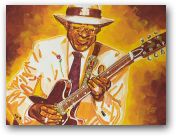
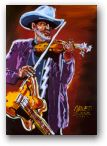
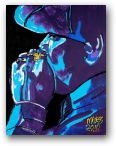
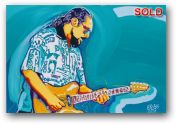
Michael Maness paints a colorful picture – especially when he tells his life story. The 2009 winner of the “Keeping the Blues Alive” award for Art and Photography, whose friends and fans are a veritable palette of blues musicians, talked with me about his life, his art and the karmic canvas on which he paints.

Tell me about your evolution as an artist.

I sold my first drawing when I was 8 years old – although I didn’t know it at the time. I was flirting with my teacher who had great legs. I was a stutterer and nobody would talk to me. So I would send cartoons with funny captions up to her and what I later found out was that she was selling them to Jack and Jill Magazine. But my art truly came from the side effects of my stem cell transplant. I am a four time survivor of cancer and I died – I died on the table. I was lying on the bed while they were giving me my stem cells (after I was told by the nurse I had a 90% chance of dying on the table) when I knew I needed a new legacy. My legacy up to that point was that I was a bar whore who drank, picked up women and had lots of fun. And I also picked up the tab. I had a great job but I never worked in the town I lived in. So I came up with a marketing campaign because I had so little time to live. My marketing campaign was “give it all away”. I had been told I was not supposed to be around - I had 30 days to live, I had a week to live – and so I began my campaign.

When did you first pick up the paintbrush?

Right after my stem cell transplant! The drugs they had me on made me paranoid, violent and angry. They had me in isolation for two months. I snuck out and got arrested for assault and battery and I had no idea what I was doing. They were going to throw me in a home and put me on Prozac but I had a canvas and some paint from a job from years before so I painted this really bright picture of Santana and I didn’t yell at anybody. I didn’t yell at my mother - that is not my personality anyway - but on those drugs that’s how I was. I was nice again. So my sister literally ran out and bought me hundreds of dollars worth of paint. Suddenly I was in galleries all over the world.

How did that happen?

I gave it all away! I went to a charity tennis tournament and wanted to give them a portrait of Pete Sampras – long story short, they built me a gallery there and I sold 35 out of 40 paintings and I was on my way. Just like that.

On your website you have astonishing portraits of blues artists-what created that relationship?
How I got to the blues was I read a newspaper about the Blues Foundation needing about $10,000 dollars. So I pulled up to their offices and gave them 100 prints of BB King that I had drawn. I told them that if they sell them they could make a killing. I dropped them off, got in my car and left! So about a year later there I am hanging around with John Hahn, who is in the advertising Hall of Fame who became a songwriter/producer. I met John through Steve Cropper who is now one of my best friends. He was my idol growing up and as a kid I learned how to play guitar because I loved his riffs on Green Onion. And it’s all because I gave away a painting. Everything, everything is because I give. I just give it away. Now mind you, I have a $4000 a month medical insurance bill and I haven’t filed for bankruptcy yet. So, John Hahn was a member of the board of the Blues Foundation and they were all chatting in 2005 about having a special poster for the awards in 2006. “We want a special poster for '06 - we want something like a Mike Maness, can we get something like a Mike Maness?” And John goes I can get you Mike Maness. Eventually I got an email from John saying don’t be surprised if you are asked to do a poster for the BMA’s! I am the only artist in the history of the Handy awards and the BMA’s who didn’t charge them! And I gave them the original painting! It started an incredible relationship, so since 2005 and a half I donate to the IBC’s and the BMA’s. I was told when I won the award for Keeping the Blues Alive that when I give them my Stevie Ray Vaughn’s and my BB King’s it is like printing money. This year when I gave them my Stevie Ray Vaughn it went for more than my original paintings did. That’s how it all began.

How do you create your paintings?

I take whatever photo I can find and I draw it and then I project it on to the canvas. Then I draw in black and white. I never want to know what color it is going to be as I am drawing. I take the basic image and throw away the original picture and decide where the light is going to come from and then I decide how all my shadows are going to play. I project it in on the canvas to save time. Traditionally, you paint, then draw, paint, then draw, but if you have a template up there and you know you are not going to follow it anyway - just go for it – that’s what I do. I never know what it is going to be, I just paint until I am finished ,until I reach my “wow” factor- that’s when I can stand back and say ohh how the hell did I do that?

Where does that come from?

I have no idea. I am a trained illustrator, but this painting stuff just comes from the heart, the soul.

So tell me about Karma…

Karma is my entire life it’s 100 percent pay it forward and expect absolutely nothing in return.

You live without expecting a return.

It feels so good – it’s amazing when you hear that you have helped to raise $38,000 for a charity in one hour! In 2007 I was onstage with Steve Cropper. I had painted an actual guitar on the front and on the back. Steve wrote the lyrics to Sittin’ on the Dock of the Bay on front and on the back he wrote the lyrics to In the Midnight Hour. The bidding started at $5,000 and then went to $10,000. It closed out at $22,500 and I got kissed full on the lips by Tanya Tucker. This is what happens when you give.

You’ve met some incredible blues musicians because of your work.


Pinetop Perkins was in my gallery Friday. I had met Pinetop in 2006. I had done a painting of him and I wanted to give it to him. We had just gotten a brand new baby grand piano on consignment for the gallery so when he walked in he was asked if he would like to play it. He smiled and gave an impromptu concert for us! We put my painting up on the piano in front of him like it was sheet music. I have some great photos of that moment. Do you know what he plays when he’s thinking about what to play next? Jingle Bells. It’s great. Then there’s Hubert Sumlin. He’s cool. He died once too. He flatlined and went to heaven. We had a great discussion in 2006 about dying. It was a spiritual discussion about death – very interesting. A few days later I saw Hubert pushing Pinetop in a wheelchair. A 94 year old pushing a 98 year old! Hubert said to me “I’m not good on names but I know you and I had a great talk once!”

I am interested in what I would call a transformative moment when you were in that awful space following your stem cell transplant and you picked up that paintbrush. You were obviously able to tap into to something and express it.

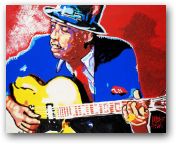
I only paint bright – people want me to paint dark but I won’t I won’t paint negative. Bill Nelson, one of the most incredible colored pencil pastel guys I know wrote me a letter and in it he said “Mike, I don’t know how you did it, I don’t know how you do it, but you make color breathe.” I framed that letter. Steve Cropper said that when I paint musicians, you can hear the note. When I paint music I want you to hear the note and feel it. Right now I am painting songs. I paint my vision of a song. When I am finished the songwriter writes his lyrics on it and the artist signs it and it sells for thousands of dollars for charity.
What do you hope for when you paint?

I want to create three things in people – I want them to say “Ahhh” or “Oooh” or just smile.

So you somehow infuse life into what could be two dimensional; you breathe life into it.
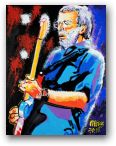

Eric Clapton’s production director saw a painting I did of Clapton and asked me how I knew that when Eric was really into it, his hair stands up on his arm. I said “huh?” He said “look what you did to his arm!” And somehow or other it looks like his hair is standing up on his arm and I remember when I did it – when I painted it - it was that “wow” moment for me.

So you are tapping int o something “other.”

My whole life is “other.” It is karma. I am lecturing to a college art class and I am supposed to tell them how I do it – how I paint. But I have no idea. I paint in the dark and I just grab color. Half the time you can’t see what the colors are – you are in such euphoria.

Like a zone of sorts.

Or else I’m a very big flop and I don’t know what I am grabbing! I don’t know where it comes from but it comes.

When you consider the original blues artists and you consider that their songs were born out of something tragic or harsh or painful and yet somehow they created this amazing music –do you feel that your own life has been born out of something painful and yet you have been able to create something very beautiful, very alive…


I decided that I am not going to be brought down. These wonderful things are happening to me and I don’t know why and I’m not asking. There is no bad and as long as you look at the world as if there is no bad – then there is none.

“I used to see the world in black and white, not a contrast of right and wrong, not in popular culture, but in life and shadow. Now because of changes in my life I see the world through a kaleidoscope. I see the colors that make up a color. I hope to show through my colors and tone that happy ending.” –Michael Maness on his website.

To view Michaels’ art go to his website at: www.artbympm.com.

A Bodacious Interview with Jimbo Ross by Maureen Elizabeth


To say that Jimbo Ross is an eclectic performer is an almost laughable understatement. When your bio includes being a session musician for Peter Townsend, , Bob Dylan, Johnny Mathis, the Moody Blues, Roy Orbison, Elton John and a tour with Led Zeppelin (to name just a few of the many artists listed) it becomes apparent that his knowledge and talent has earned him huge respect and demand in every genre. The electric viola is his instrument of choice and my interview with him revealed a deep respect and love of the blues that he has translated onto an instrument that, for most of us, doesn’t come to mind when thinking of the blues.

Tell me about your musical roots.

I left home at 16 so that I could pursue my music. I was supposed to be an insurance salesman. My dad was from Chicago and he would play piano by ear. He was just a great guy and he knew he needed to support his family. He wanted me to become an insurance salesman just like him.

Did your love of music originate from him?

I have always loved music, it was my world. It was the place I could go to - my escape. I was the youngest in the family and I was begging my folks to let me play the piano. My best friend was going to learn to play the viola so we signed up for lessons together but he quit a week later. With the viola I could go into my room and shut the door and be in my own world. I got my first guitar when I was 9. My whole hook up to music was listening to the Wolfman Jack show, listening to old soul, R&B and blues. The music just floated my boat – it was calling me, you know. XLRB was a radio station out of Tijuana and we could get it in LA. I heard James Brown, Sam and Dave - I was just drawn to the expression of the blues because it was just such honest soul wrenching music. It cast a spell on me.


Your first CD was “Driven by the Blues”…

That CD was done completely live. I did 10 tunes in one day.

Was that the plan?

That’s just the way it happened. I had ten tunes and my players were all great players and we just decided to do it. It was Aug of 1997 and I found out my guitarist was leaving and he was the one I wanted. You know there are unique guitar players that stir you in places that just floor you – he was one of them and I had to have him on my CD. It took the next year and a half to finish the record, adding vocals, producing and when I was done I got what I feel is a state of the art, top class record.

When did you decide that this would be your life?

I always knew music was going to be my life. I played music by ear, I was self taught, I played blues, just a natural blues -funk -rock –R&B- soul guitar. I listened to Lightning Hopkins, Muddy Waters, Willie Dixon, Freddie King and Johnny Winter. Winter was a big influence, his raw expression from his early years. Johnny just listened to blues records ‘cause he couldn’t work in the field -so he stayed inside and played guitar. He was a white guy doing the blues and I was a white guy doing the blues and he just showed me that I could do it. I listened to Eric Clapton when he was in the Blues Breakers, he was a little too clean but he did it well. Never really patterned myself after any violin players. I had listened to so many but I loved swing bands. I listened to swing music, 30’s swing stuff. I had a hot club type band in the 70’s and I would throw in the greasy notes. No matter what I was playing it would always pop out. If you have something to say - you have to say it. That’s what blues has taught me. It’s the expression of the blues. I don’t care how many notes you play, you put together a conversation. Most jazz greats have a love of blues influence. I had a jazz rock fusion band and we played all well crafted instrumental music. I love classical, but as far as self expression, I love the blues. All blues are happy blues. Willie Dixon says you find the silver lining inside the clouds.

Does that ring true for you?

You find the joy inside the sadness, inside all the feelings. Like the expression “tears of joy.” When I am in zone it is where I come from. People want to feel the move, want to feel what you are feeling. I want to see someone connected - I want to feel the connection, if you take someone on the journey with you it spellbinding. That’s the kind of performance I signed up for. I don’t want to go through the motions.


The audience wants to see the person on stage not only connect to the music but to connect to them as well.

And this makes a really great relationship! Ever since I was a kid watching the Ed Sullivan Show, eating ice cream in my pajamas, watching Sam and Dave, Elvis, Wilson Pickett.

And the Beatles?
Oh I was Ringo. I was in elementary school. Paul was all the girls’ favorite but Ringo was cool and goofy and had a cool name. CCR, when they came out I said “all right!” Southern revival, John Fogerty had an honesty about him. The Allman Brothers are my favorite jam band of all time. I wore out Live at the Fillmore.
We got spoon fed English blues. The English ate up everything about the blues and spoon fed it back to the United States. It was the beginning of the British rock invasion and that enabled us to get the blues artists onto the stage. And then Freddie King got to be in Woodstock. The only way I could get my medicine was from Wolfman Jack in my room. I would go to these record stores in LA and I would buy my records. I still have a bunch of them.

As a self taught musician you have been able to live your dream?

Oh yea, it was hard, but there came a time when I quit playing guitar and I would play the viola. The viola is in the middle of the orchestra – it’s like the alto in the choir. We’re playing all the color, the harmony. After all the years of playing the color and the harmonies - that was my teacher. It helped me be able to hear harmony so I could improvise, so when I would hear the chord changes I could hear the harmonies that were supposed to go with them. How to let your backbone slip and do the wild thing on the viola is a whole other thing. I play a 5 string electric viola. I’ve played salsa, fusion, swing, bluegrass and Irish music on it for fun. I was in a Celtic rock band. I’ve been a featured soloist in different movies. You have to have the ability to bring it alive…

I learned about your music through an interview with Lennie Jones, the artist who created the cover painting for your latest CD “Steady Rollin’ Man.”

Lennie and I talked for hours on the phone and I told him there’s got to be a train, gambling and women. He said that’s a little much on a 5x5 CD cover! But he put the paintbrush on the canvas and he said it just came to him, it came together overnight. He captured my vibe and we hadn’t even met. The title “Steady Rollin’ Man” says that I’ve been at it my whole life and I’m still rollin’. You can’t stop me. My first album “Driven by the Blues” - I had to get that out. I was driven. I had been around the world in 180 days being a session player and I’ve been in all kind of bands because I feel the passion. It’s the blues that I identify with. It helps me be a better player no matter what I play. Lennie dug what I was all about. I’m still rollin’ - I take my time, I’m in no hurry, I don’t let the small stuff get me down. Sometimes the music people don’t know how to take me because nobody is doing what I’m doing. We put on a show; one guaranteed rocking’, good time. We are a Bodacious Blues Band. “Bodacious” is a word in some dictionaries but more like a slang word. Harvard College dictionary defines it as “noteworthy and up standing.”

When writing a song, what’s your approach?

I start with the groove. I walk the dog. I take the dog out for a walk then I get the bass line going in my head. I get a groove and a hook and a line. I have to be moved by something out of my own experience and write down ideas, a few words that mean something to me. I’ll come back to it maybe with a musical fragment from something else, even with the lyrics. It’s not all about bad luck and misfortune. I like to be a little optimistic about my blues. It’s about hope. If people feel better it’s going to be okay. I have the blues to help me through it. The violin was Clapton’s first instrument. It was Jimmy Page’s first instrument. That’s why he pulls out the bow when he is in Zep. I played with Page and Plant when they were on tour. I was just doing the string section playing Kashmir and Black Dog. I got to play with some of my mentors; I was able to play with James Brown.


So tell me about the blues and the violin.

I play blues licks on the violin. I chose to move what I was doing on guitar and do it on the violin and it sounds like a slide. It’s a righteous, raw feeling. There are no frets so I can play all in between the notes. It makes people crazy. That is the color, the color of the blues - it’s the stuff between the notes that gets under peoples skin and they go ohhh yeahhh. You can’t do that on the piano. I put some emotion behind it, move the notes around and make it talk. I reach in grab your soul and move your spirit - that’s when you’re doing something right. It’s the zone, it‘s not thinking, not the intellect. It is total feeling, deep emotion, honest, gut wrenching feeling. Sometimes it is very subtle where you back off just a little. You are telling a story the way you color your notes, the way you use words, it becomes who I am. It is off the cuff, it’s being able to improvise. It’s so much more fun, so much more colorful, so much more interesting, a righteous and raw bending of the notes.

In an American Blues News interview with Kim Simmonds it occurred to me how interesting it is to talk with people when they have the ability to look back and reflect, finding that sense of having lived a good piece of their life. And what I am finding, especially with musicians, is that they want to continue and that they are very happy that this is the path that they have chosen, no regrets.

Oh absolutely. We are on a mission. This is what we got to do. The other chapter of my life is unfolding. I am embarking on that which is what I wanted to do in my 20’s but I wasn’t old enough or mature enough, then, to do it. I am not a household name but I'm still doing it old school style- get enough people to hear it – give me a chance to get up there, and do it, give me a stage and I’ll prove it!
Go to www.bodaciousrecords.com and check out Jimbo Ross and his “Steady Rollin’ Man” CD and for those of you in CA watch for his live appearances – he promises he will get the party started!

The Pittsburgh Blues Festival interview with Ron "Moondog" Esser by Maureen Elizabeth

“Mealtime at the City Shelter” by Bruer Tidman www.bruertidman.com

Authenticity. That’s why we like our blues. The blues are genuine and from the heart. My interview with Ron “Moondog” Esser (owner and operator of Moondog‘s and the Starlite Lounge in Pittsburgh, PA) revealed to me an authenticity that I had not expected. Moondog has a rep. He is established as a earnest supporter and promoter of the blues in western PA. His club attracts national acts from the New Rider’s of the Purple Sage and Savoy Brown to Devon Allman. The painted walls inside his club boast photos and autographs of blues legends that have journeyed to his nightclub in anticipation of a welcoming audience. His rep includes an award for “Blues Club of the Year” and even more recently his restaurant, the “Starlite Lounge,” was featured on the Food Network. But most importantly - to him- is his association with the Greater Pittsburgh Community Food Bank and their annual “Pittsburgh Blues Festival.” This festival, begun in 1994, has one goal - to raise money and collect non-perishables to help provide food to those who are hungry. And they work hard to meet this goal. Every year they provide roughly 21 million pounds of food to families. 21 million pounds. I spoke with Moondog a few days before the festival line up was announced (and promised not to “leak” any information prior to the official announcement…).

How did your association with the Pittsburgh Food Bank come about?

About 16 years ago my friend Phil Harris called me and asked me if I wanted to be on the committee to help the food bank with a blues festival and I said if it helps feed hungry people I’d be glad to be a part if it. We raised $7,000 the first year when the festival was held at the Riverplex and every year it got better. We have changed venues 4 times and we are now at Hartwood Acres - we’ll never leave Hartwood, it’s a great venue. Eventually we decided to make Friday a “Free Friday” by asking donations of a bag of canned goods. We have collected tons, tons of food - something like 19 tons last year. We do “Free Friday” to help promote the festival - if you come on Friday with a donation and see what good shows are offered, maybe you’ll come back for Saturday and Sunday.

Do you have a goal?

I just want to do better than the year before - that’s the goal.

Do you find people becoming more generous because of our economic situation?

I think that even though people don’t have money now, they kind of realize how hard it is for many families and they are even more generous. Pittsburgh is a good town. Pittsburgh is a blue collar town and our people are very giving. And they know that if you can’t eat you can’t live - period. There are horror stories we hear about families being unable to feed their kids.

How do you choose the bands for the festival?

I stay up for hours and do web searches plus utilize my relationships with the agents. Then I see if we have enough money to make it work. This year was pretty easy. Two years ago everyone went to Europe to tour because of the economy - that was tough. We try to be as different as we can. This year we have Eric Burdon and the Animals - we have tried to get him for a few years. Our headliners this year are the strongest we’ve had yet.

Last year we interviewed Tinsley Ellis and he had nothing but words of respect for you for how hard you work to keep the blues alive and for your dedication. Where did your interest in the blues begin?

I always liked music since I was a little kid. Blues players, in my opinion, are the best players there are. Blues players are so much more authentic, more from the heart. I always liked the blues guys - they’re all cool, they’re funny and have the best stories. It’s a life style and they play it because they love it. Many play it because their parents did, it’s a way of life. It comes from a different place.

Tell me about working with the Greater Pittsburgh Community Food Bank…

The people at the food bank are so dedicated to what they do it’s amazing, I love them all. There is a reason why they work there - they work there because they really care. They are all very talented and could work other places and make more money but they are all on a mission and care about what they do. It comes from their heart.

Obviously you come from that same space…

My dad was a public servant. He was the mayor, fire chief, and he told me you have to help other people who are less fortunate. A lot of people ask me about certain things in my life - we won the Blues Club of the Year award and we were featured on the Food Network - but by far what is my biggest accomplishment in my life - besides my wife and son, my family- would be the food bank. The first two years we raised over $10,000. Last year we raised $200,000. Everybody in the area gets behind it, our great sponsors, and every year more people, more businesses become involved. We have Mike Lang who, every year, is there for us. WDVE is great, the media is great, they do everything they can to help promote this event. And I would love to see more sports figures and community officials involved.

Is there anything else that folks should know about the Pittsburgh Blues Festival ?

For what it costs to get in, and the amount of entertainment you get, the price is ridiculously low - every penny goes to the food bank - we don’t get paid. We have a budget, we pay the bands, we pay the sound company. If I bring a can a food in and say “here” - that can of food goes to people who need food. And it’s fun! Come and have fun! It’s really important to the community. For what it cost and what it does to help people it is hands down the best thing you could do.

FOOD FOR THOUGHT

We are all just one step, one heartbeat, one plant closing from struggling to put food on the table. The Greater Pittsburgh Community Food Bank has been in operation since 1980. It is a non-profit 501(c) (3) organization that provides numerous services to those in need in the greater Pittsburgh area. By bringing one grocery bag of non-perishable food on Friday night July 23 you can enjoy the music of Chubby Carrier and the Bayou Swamp Band, The Iguanas, and Miss Freddy and Blue Faze. For a $40 two day pass (July 24 & 25) you can see Eric Burden and the Animals, Sue Foley and Peter Karp, Nick Curran and the Lowlifes and the Pittsburgh Blues All-Stars (July 24). On Sunday you will see Kenny Wayne Shepherd, Larry McCray Band, Tinsley Elis and many more - all the while knowing that the cost of your ticket will benefit your neighbors in Pittsburgh.

For more information on the Pittsburgh Blues Festival go to: www.pghblues.com. Or call the Blues Hotline @ (412) 460-BLUE

For more information about the Greater Pittsburgh Community Food Bank and the many programs they sponsor (or if you need help) go to: www.pittsburghfoodbank.org.

For information about Moondog’s and the Starlite Lounge go to: www.moondogs.us.

American Blues News Staff

What makes American Blues News unique is our coverage across America. Here is our lineup:

Mon: Memphis Correspondent - Robert "Nighthawk" Tooms
Nighthawk is our resident globetrotter and man behind the scenes, as he tours with the Reba Russell Band.

Tues: New York Correspondent - J. Blake
Blake is the American Blues News review and interview guru. You may catch him out and about in NY playing the blues.

Wed: National Correspondent - Monica Yasher
Monica is our executive director and artist interview specialist. You can catch Monica singing the blues around Pittsburgh or working on some country music songs in Nashville.

Thurs: Washington, DC Correspondent - Virginiabluesman
Geraldo offers inteviews and reviews. You may have seen him at an Ana Popovic concert or conversed with him on her websites, as he offers administrative support with her music.

Fri: Northeast Photographer - Nelson Onofre
Nelson offers a Friday column of blues photography and pictorial support for the interviews covered by the team.

Jim Stick in Colorado
Jim will be focusing on the Blues Festivals in the beautiful state of Colorado, and the artists that live and visit there.

Maureen Elizabeth, our resident art correspondent, will be focusing on blues art as she explores the creation of CD covers, or speaking with artists who also have a love of creating pictorial art in addition to their music! She may also feature some of her good friends in the Pittsburgh area. In her love of art, you may find Maureen's photography accompanying writer's articles on our pages. Maureen is also our marketing director.

Pittsburgh correspondent and photographer, CR Bennett, will share the Pittsburgh scene with all of you. You may also see CR's pictures accompanying other writer's articles.

We head to the big state of Texas! Abby Owen, our Texas correspondent.

Another big area to cover, the West Coast with Casey Reagan, Casey will feature many artists and events on this ocean's shores.

Lastly, we have our roving blues entertainment writer,
Chef Jimi.

And of course, we will surprise you sometimes!

 
Internet Marketingdata recovery